The Balance to Baseline™ program
Meet the baseline.
Not more. Not less.
Most shops do not fail because people are lazy. They fail because nobody wrote down what good looks like — so a job takes however long it takes, a quote is however the estimator felt that morning, and the invoice is a negotiation.
Balance to Baseline is a business operating framework that puts a measurable standard on every activity in the company, and then holds the whole organization to meeting it. Not beating it. Not quietly missing it. Meeting it.
It is a consulting program, and it is now a set of modules in the software. We help you build the baselines, and then the platform measures them for you, on every job, forever.
All of it free, no form and no email address — the complete framework as a PDF, all five pillar workbooks with their forty-four task worksheets, and ninety-five minutes of audio.
On this page
- Five pillars, twenty-four disciplines
- The technician hour problem
- The employees write the SOPs
- The loop that never stops
- The person who finds the bug is the hero
- The balanced scorecard
- What the software already measures
- The pledges — both ways
- Take the whole thing — book, workbooks, audio
- How an engagement runs
Five pillars, twenty-four disciplines
Every activity in a service business falls into one of five pillars. Plan. Sell. Execute. Collect. Improve. Underneath them sit twenty-four disciplines — and each one gets a number.
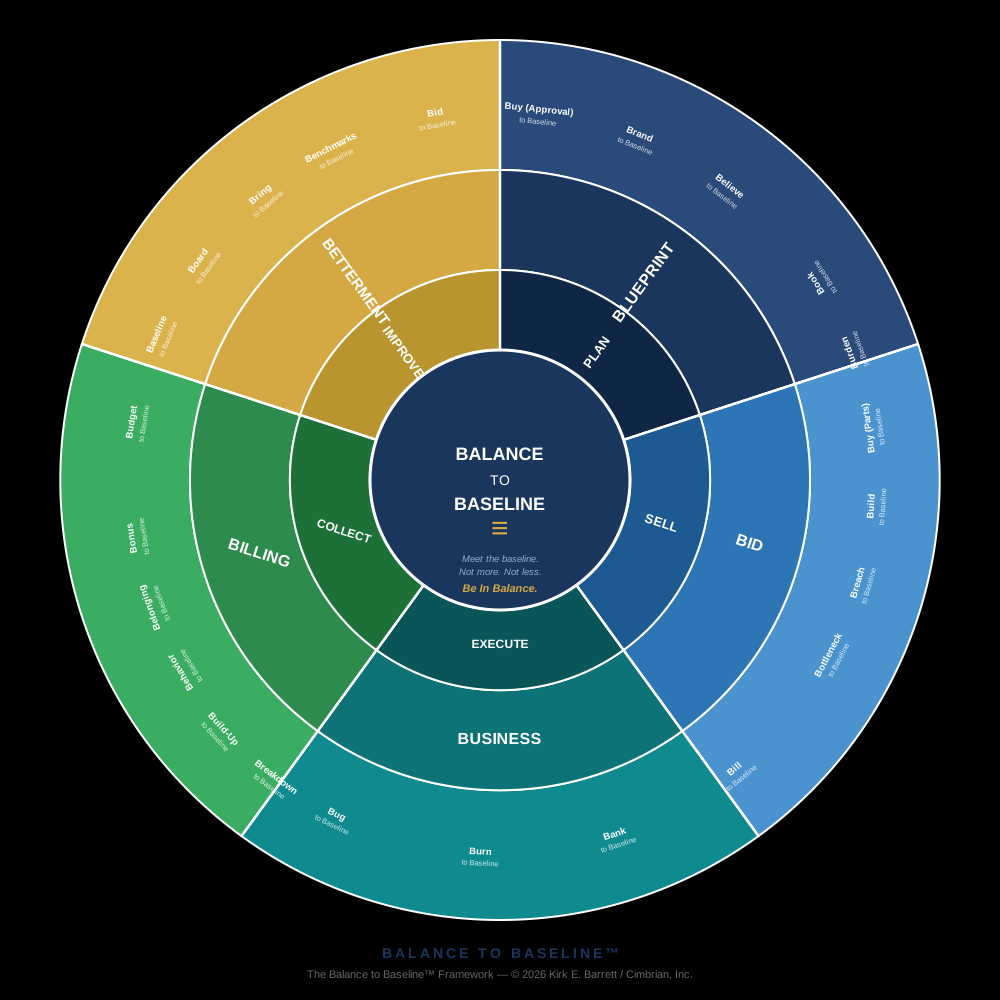
The wheel. Every spoke is a discipline, and every discipline gets a number.
Blueprint — Plan
Budget · Baseline (SOPs) · Board · Bring · Benchmarks
Flat-rate books, written procedures, leadership cadence, hiring to plan, and the numbers that define what baseline actually means.
Bid — Sell
Bid · Buy (approval) · Brand · Believe
Quotes built from the book rather than from a feeling. Approvals and not-to-exceed increases handled before the work, not after.
Business — Execute
Book · Burden · Buy (parts) · Build · Breach · Bottleneck
Scheduling, field work, parts, projects, callbacks and the places work gets stuck. The biggest pillar, because it is where the day goes.
Billing — Collect
Bill · Bank · Burn
Invoice turnaround, days sales outstanding, cost control. The pillar that decides whether the other four were worth doing.
Betterment — Improve
Bug · Breakdown · Build-Up · Behavior · Belonging · Bonus
Defects, recovery, training, culture, retention and pay. The pillar most frameworks leave off, which is why most frameworks stop working in year two.
The technician hour problem
Here is the whole economic argument in one sentence: you can only ever bill the customer for the amount that was quoted and approved — no matter how many hours it actually took.
| The tech finishes early | The tech runs long |
|---|---|
| They clock out. You just gave away billable capacity, and the customer got less than they paid for. | You absorb it. You cannot go back for more money on an approved number after the fact. |
| Use the time. Document a defect. Photograph a coil. Change a filter. Generate the next quote. | Say so immediately, get the increase approved, and keep working — or book the return trip. |
| And report the real hours — because a budget that is too generous is something we can only fix if you tell us. | And report the real hours — because a budget that is too tight is costing you, not just the company. |
Which is why the framework is emphatic about one thing, and why it is built into the software rather than written on a poster: nobody is rewarded for beating a budget. Beating it by forty percent is not excellence — it is you telling us our book is wrong, and we should thank you and fix the book.
The employees write the SOPs
This is the part that makes it different from every process initiative your people have already sat through and ignored.
Management does not write the procedures. Consultants do not write the procedures. The CSR who accepts portal jobs writes the portal acceptance procedure. The technician who runs preventive maintenance writes the PM checklist. The dispatcher who builds the day writes the scheduling procedure.
-
They write it
On a worksheet that asks the right questions: what triggers this, what goes in, the steps, what tool you use, what comes out, who you hand it to, what the standard is, what people usually get wrong, and how long it should take.
-
They present it
To their peers and to leadership. Feedback goes in. It gets published. Nobody is handed a binder written by somebody who has never done the job.
-
They own it — permanently
Their name is on it. They keep it current as the process changes, and they are the one who trains the new hire on it.
-
And then it runs itself
Because in our software that procedure is not a document. It is a workflow — it fires on the event that triggers it, walks the person through it on their phone or their screen, and records that it was done.
There are forty-four of these worksheets, across five workbooks, one per pillar. They are the execution engine of the program: the flat-rate books, the portal procedures, the parts and truck stock standards, the invoice and collections calendar, the defect log, the bonus structure. Every one produces a written standard with a named owner and a number attached.
The loop that never stops
A baseline is not a target somebody sets once and forgets. It is the current best answer, and it gets better every month you run the business.
-
1 — Set the baseline
From the flat-rate books, your own job history, customer SLAs and industry standards.
-
2 — Execute to it
Techs work the budgeted hours. Portals are updated on schedule. Invoices go out inside 48 hours.
-
3 — Collect the data
Actual against budget. Parts cost against estimate. SLA compliance. Days to collect. Callbacks.
-
4 — Analyze the variance
Which job types are we consistently over-budgeting? Which equipment generates callbacks? Which zone is slowest to respond?
-
5 — Adjust the baseline
Tighten where you are generous. Add room where you are not. Update the books. Create the new parts kit. Retrain.
-
6 — Repeat, forever
Every completed job makes the next budget more accurate.
And the system tells you when your own numbers are wrong. If almost everyone hits a baseline easily, it is too loose and it is costing you on every quote. If hardly anyone hits it, it is unrealistic and it is costing you people. Both show up in the data long before they show up in a meeting.
The person who finds the bug is the hero
This is the part of the framework that changes a company, and it is the part most owners have never been shown.
There is a 110-year-old electrical contractor in York, Pennsylvania called I.B. Abel. Since 2010 they have cut their OSHA incident rate by 400%, all but eliminated lost-time injuries, and hold a 0.00 DART rate and a 0.91 total recordable incident rate — while tripling their workload and growing the company 500%. They are one of the safest contractors in America.
They did it by never blaming an employee.
Their mechanism is a Good Catch Program: employees are rewarded, publicly and consistently, for reporting near-misses and potential problems before they become incidents. No punishment for reporting. No blame for the person who surfaces it.
Balance to Baseline takes that and applies it to every process in the business, not just to safety.
A quote that takes four days
When the standard is two. That is a bug.
Parts ordered from the wrong branch
Every time, by everyone. That is a bug.
The Tuesday update that never happens
Because the CSR has a standing meeting. That is a bug.
“The book is two hours short on this repair”
A technician saying that is not a complaint. It is the most valuable report in the company, and it is worth money on every future quote.
None of those are failures of people. They are failures of process — and the person who reports one is doing the company a service.
What happens when you actually do this
It goes in three stages, and the first one looks like bad news and is not. Knowing that in advance is what stops an owner killing the program in month two.
-
Reports go up
Sharply. Not because anything got worse — because things that were always there stopped being hidden. This is the system working. An owner who reacts badly here teaches everyone never to report again, and gets a quiet company with all the same problems.
-
Resolution accelerates
Leadership can finally see problems it never knew existed, so they start getting fixed instead of absorbed.
-
Then reports trend down
Because root causes are genuinely gone, and people are proud of processes they own and improved themselves.
And this is where the software earns its place
A Good Catch program run on a shared spreadsheet dies in six weeks. It dies because reporting is slow, because nothing visible happens afterwards, and because nobody can prove it changed anything. All three of those are software problems.
Report it in under two minutes
From the phone, in the van, at the counter, on the roof — a workflow like any other. Defect, near miss or good catch. What happened, where in the business, how often, what it cost, and what you would do about it. Photograph it if that says it faster than typing.
A scoreboard that celebrates
Public, by person and by zone, counting catches made — never mistakes attributed. Reports you filed is a number that goes up and is worth having your name against. It belongs in a review as a credit, and it belongs on a screen in the shop.
Every report lands on a procedure
A report names a part of the business — and the system already knows which procedure governs it. So a catch does not go into a list. It attaches to the SOP it is evidence against.
Or proves one is missing
When reports pile up somewhere with no procedure behind it, that is the system telling you where to write the next one — ranked by what it is costing you. No more guessing which SOP to build next.
And it closes the other way too. When a fix lands, the people who reported it are told — by the system, by name. Nothing kills a reporting culture faster than reports going into a void, and nothing sustains one better than watching your own catch change how the company works.
In build Good Catch is the next thing we are building: the reporting workflow on the handset, the no-blame scoreboard, and the correlation from a report to the procedure it indicts or the one it proves you need. The workflow engine, the event layer and the SOP objects it stands on are all shipped — this is the surface on top of them.
The balanced scorecard
Every role gets its own scorecard, built from the disciplines that role actually controls. Not a company dashboard nobody recognizes themselves in — the eight or nine numbers that describe your job.
Technician
Hours to budget · utilization · first-time fix · callback rate · same-day diagnostic · value-added time when finishing early · truck stock accuracy · honest time reporting
Dispatcher & CSR
Job acceptance inside SLA · status update timeliness · approval-increase turnaround · team utilization · schedule accuracy · close-out inside 24 hours
Service Manager
Team utilization · team hours-to-budget · team callback rate · quote accuracy · retention · truck stock audits · training completion
Zone Manager
Revenue to budget · gross margin to budget · days sales outstanding · SLA compliance · callbacks · staffing to plan · turnover · composite baseline attainment
Estimating & Purchasing
Quote turnaround · quote accuracy · parts-kit usage · win rate · order placement inside four hours · parts cost against quoted · preferred vendor share
Billing & People
Invoice turnaround · invoice accuracy · DSO · collection rate · dispute resolution · time to fill · onboarding completion · payroll error rate
Everyone can see their own, live, at any time. That is not a nice-to-have — it is the thing that makes the whole system feel fair instead of feeling like surveillance. You cannot hit a target you cannot see.
Attainment accumulates like a bank balance and pays out on a cycle long enough for people to spot a problem, fix it and recover. And the bonus pool only funds if the company hits its baseline too — so it is genuinely shared.
What the software already measures
This is the reason the program and the platform belong together. Most of these numbers are not something anybody has to collect. They are a by-product of the work being done in the software in the first place.
| The baseline | Where the number already comes from |
|---|---|
| Hours to budget | The task carries the time budget. The visit carries the real clock. |
| Utilization, and where the day actually went | Travel, idle on site, and billable work are three separate stamped intervals — not one lump. |
| Callback rate | Repeat visits against the same site and the same piece of equipment. |
| Quote turnaround | The quote’s timestamp against the diagnostic visit that triggered it. |
| Invoice turnaround and days to collect | The invoice is the same document as the quote, at a later stage. The dates are already on it. |
| Parts cost against quoted | The purchase order line knows which job it was raised for. |
| Truck stock accuracy | A van is a warehouse here, so a count is a count. |
| Procedure compliance | The workflow run either happened or it did not, and it is stamped with who and when. |
| Onboarding completion | A checklist anchored to the person rather than to a job. |
And the interval nobody else can show you is the interesting one. Arrived, but not yet working: badging in, finding the contact, waiting for access. Most systems have no way to even record it, so it hides inside “labor” and everybody assumes it is small. It is not.
In build The baseline layer itself — targets with tolerance bands, scoped to a person, crew, department, zone or the company, effective-dated so a tightened baseline never rewrites last quarter, and the attainment rollups behind the scorecards above. The operational data is all there today; the measurement layer on top of it is what we are building next.
The pledges — both ways
A standards program that only makes demands of the people doing the work is not a standards program. It is a stick. So the framework has two sets of commitments, and the second one is the reason the first one works.
Everyone commits
I will plan my work and work my plan.
I will meet my baselines. Not more. Not less. In balance.
I will report honestly so our data makes us better.
I will never hide a problem. The person who finds the bug is
the hero.
I will use my time to create value, even when the primary work is
done.
I will communicate immediately when I need more time, parts, or
help.
I will raise my hand when something is not working.
And leadership commits
I will never blame the messenger. I will fix the
process.
I will assume good intent, because even the best people make mistakes
— and mistakes are how we find what to fix.
I will be transparent with our numbers, our plans and our challenges,
because you cannot hit a target you cannot see.
I will budget honestly and never ask you to hit a number I would not
bet my own paycheck on.
I will never use technology to replace you. I will only ever
use it to make your job easier and our company stronger.
I will protect your job when you protect our standards.
Take the whole thing
The entire framework is written down, and you can have it. No form, no email address, no call first. Read it, argue with it, hand it to your leadership team, and decide for yourself whether it describes the business you want to run.
About a hundred pages: the philosophy, all five pillars, every discipline with what at-baseline and below-baseline actually look like, the metric tables for every role, and the twelve-month roadmap.
Worked through a fictional national HVAC operation — Franklin Air Solutions, 135 technicians across sixteen zones — so every number and every example is concrete rather than abstract.
And the five workbooks — take those too
This is the part most frameworks keep back. The book explains the philosophy; the workbooks are where the work actually gets done — forty-four task worksheets, one pillar each, every one designed to be printed, handed to the person who owns that process, filled in by them, and presented to their peers.
Each worksheet carries an ownership table, the items to define with a baseline value against each, and the full procedure framework: purpose, trigger, inputs, the steps, tools, output, handoff, the standard, the common mistakes and the time budget.
1 · Blueprint — Plan
Tasks 1–12. Flat-rate task and job books, parts kits, revenue targets, utilization, the SOP master inventory, customer-specific procedures, leadership cadence, staffing, onboarding, KPIs by role.
2 · Bid — Sell
Tasks 13–20. Quote template, turnaround standards, the accuracy feedback loop, approval and increase management, brand guidelines, satisfaction tracking.
3 · Business — Execute
Tasks 21–30. Scheduling, update cadence, time tracking, the value-added checklist, parts procurement, distributor agreements, truck stock, project planning, callbacks, bottleneck mapping.
4 · Billing — Collect
Tasks 31–35. Invoice procedure, the collections calendar, cash flow forecast, expense budgets, parts profitability.
5 · Betterment — Improve
Tasks 36–44. The defect log and Good Catch program, incident protocols, skills matrix, development plans, code of conduct, engagement survey, bonus structure, recognition, retention.
All five are free as well, and they are the same worksheets we would walk you through in an engagement. The difference an engagement makes is not access to the paper — it is somebody sitting with your team while they fill it in, and the software measuring what they agreed to afterwards.
Or listen to it
The whole framework, read aloud. Ninety-five minutes, in two parts — about the length of a drive between two sites.
Part 1 — Foundation & philosophy · 60 min · download
Part 2 — Execution & culture · 35 min · download
How an engagement runs
Twelve months, four phases, across every zone at once. The software goes in alongside it, so the baselines you write in month two are being measured by month four.
-
Months 1–3 — Foundation
Build the flat-rate task book for the service types covering most of your volume, and the jobs book with parts kits behind it. Write the revenue-critical procedures first: intake, quoting, approvals, dispatch, time tracking, parts, invoicing, collections. Set the standard truck stock. Kick off with everybody in the room.
-
Months 4–6 — Execution
Every quote comes off the book. Approval and increase workflows are live. Invoice turnaround is enforced. Everybody knows their own numbers and can see them. Data starts accumulating.
-
Months 7–9 — Measurement
First real budget-to-actual review. The flat-rate books get rewritten against ninety days of what actually happened. Recurring custom quotes become parts kits. Callback root causes surface. The defect log is running and closing things.
-
Months 10–12 — Optimisation
First bonuses paid on baseline attainment. Second adjustment round. Engagement survey. Full year review, and next year’s budget, baselines and staffing plan built the same way.
The Balance to Baseline™ framework — its structure, pillar architecture and B-to-Baseline naming convention — is © 2003–2026 Kirk E. Barrett and Cimbrian, Inc. All rights reserved. Delivered with Listrak and ServiceProof.